
A unique shade of pink- part 1
- Gyorgy Henyei Neto

- Apr 12, 2025
- 4 min read
An object, a simple thing, can tell stories.
That's what I believe, that's why I collect, look for, and seek interesting things, and that's what the idea of a museum really is.
In a museum space, the curator expects that the object, that being a pipe or a fern, a tent or the sarcophagus of a Pharaoh, can tell a tale on its own.
Maybe not the full story, maybe not the detailed historical account or specific situations, but an object, given a context, a meaning, can give us a way into how and when that things has come to be.
Sandra Dudley, museum professional and professor of museology, points out the incredible gravitas that an object has, even wihtout any sort of contextual or historical perspective. In her article discussing the visceral relationship between humans and materials, she says:
My initial response to the horse was a fundamental, emotional, sensory, even visceral, one to its form, materials, colour, scale and texture. Had the information about the horse been displayed next to it in the form of a label or text panel, I am certain it would have interfered with, even prevented altogether, the powerful and moving reaction I had to the object for its own sake: I would have been distracted by the text, would have been drawn to read it first, and would not have had the opportunity to experience and sensorially explore the artefact’s physicality for its own sake. That is, I would not have had the powerful experience that I did, had the object been displayed in a way that impeded my ability to encounter it alone, in and of itself, before I discovered the crucial, contextual information the gallery had provided for it.
The viscerality of this relationship between the human interpretation and the raw physicality of the object, is what provides us witht the incredible, and sometimes overwhelming, passion for the material thing.
I love collecting. I have many and multiple collections. Some of them I catalog, position, reveer; some others I enjoy touchiing and feeling. But all of them come from this need to know and learn.
Like in the Chinese horse room, my most driven motivation is not to simply catalog, list, and exhibit, but it is to discover, to touch and smell, to feel and to play.
I love collecting, and collections. I built a whole project around it, and a business is growing because of it, and more and more ideas and networks are being built through this incentive to gather, to know, and to add.
I will make time to talk about those feelings, those ideas, the projects, all in due time.
This, however, is the moment to discuss this one piece. Not the first collection, not the biggest, but the one that pushed me from mere adder to a proper collector.
Guitars. Guitars are amazing pieces of art. From design to materials, the idea of an electric guitar always fascinated me. I remember spending so much time scrolling through the internet or turning pages and pages of magazines, just staring at those magnificent instruments, tools for musicians, for sure, but also such beaultiful pieces of art on themselves. A guitar is a sounding sculpture.
Getting my first guitar was of course a dream come true. I used to just pick it up, hold it in my hands, and compare it with others I've seen. I still do that now, let's be honest.
I realised I loved playing the instrument, I loved making music, but just as much, I loved having a number of those art pieces standing in my room.
I started learning more about brands, about signature guitars, about how they were made, by whom, to whom, and that led me to having more and more guitars. I developed a tight system, which I still more or less continue to operate by. I would look and research a guitar, I would then buy it and have it for a time, and when I was ready to move to something else, I would then sell it.
That was not boredom, even less not enojoying the instrument. In my eyes I saw that as a research, a fieldwork experience, one which I decided to pass on to as many people as possible.

Again, there are so many stories in this thread, which i will touch in the future.
But for now, we will focus on the one that changed it all.
Living in Bath, UK, I continued my exploration of the world of guitars. I made friends within the local music scene, and eventually with the local guitar shop owners, with whom I shared my interests and my ideas. I believe they got what I was doing immediately, as they showed me one of their new pieces.
As I mentioned before, I am not one to make rushed decisions. I take my time, I research, I try to conceive of any and all possible outcomes for any decision I make. If I want something, I will leave it brewing for a time, quite some time, and I will not finalise a decision, for yes or no, until it has reached breaking point, and all the possible situations and outcomes have been thoroughly elaborated and tested.
That day, however, a unique shade of pink took me by surprise. A Fender strat, in champagne pink, and a rosewood neck. That was the only thing I saw. That presence touched me, its existence alone was enough to make me interested. Not specifications, price, rarity, or status. It was the Chinese horse all over again.
An item, by itself, by its own means and power, creates a connection, a story, and an experience, without the need of historical context or descriptive narrative.
The decision was made there and then, the pink steamy guitar would be part of my now growing collection.
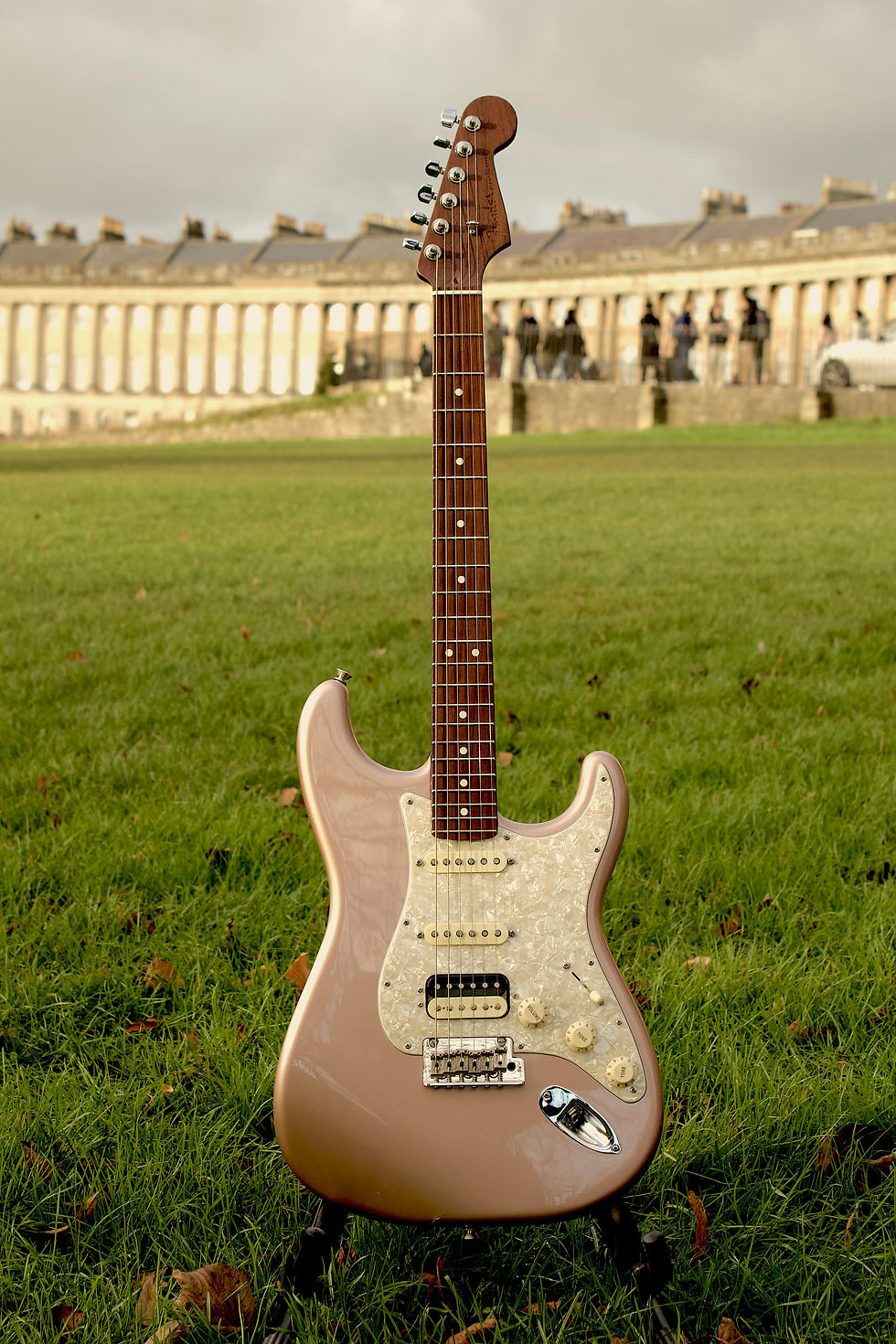
From that point forward, I decided to empower the idea of collections, and how the act of forming a network of meaning through objects, and specially electric guitars, could be a way of telling one's life story.
I have ran events and meetings about the act of collecting, and tried to bring the joy of collecting to my network. Many stories were made, many stories were told, and many tales will still be written because of this one item, my Chinese horse in a guitar shop, my Steam Pink.
Check this and more at Steam Pink's gallery.


Comments